Originally published as a co-review in TapeOp #132, July/August 2019, alongside Dana Gumbiner. The sections below are jh0st’s contribution. Still the primary DAW.
— Originally published in TapeOp #132, July/August 2019
I started using recording software — namely Cakewalk — in 1992, roughly the same year I started using AutoCAD for architecture. Cakewalk was my musician’s version of AutoCAD: where the latter made digital drafting available to the masses, the former allowed me to move from tape to digital within the ubiquitous Windows environment. Both were game changers, but new products like Studio One don’t just move the game forward linearly — they leapfrog several steps ahead.
Mid-2000s software during the Windows Vista era became the equivalent of ’80s gas guzzlers. Cakewalk, with one foot shackled to the analog world, grew bloated accommodating new functions within old form. A split-second slip of the finger would force hours of tinkering to recall a mis-toggled function or hidden window. The end result was a dread of experimenting — I’d only fire up the program when the song was mostly written.
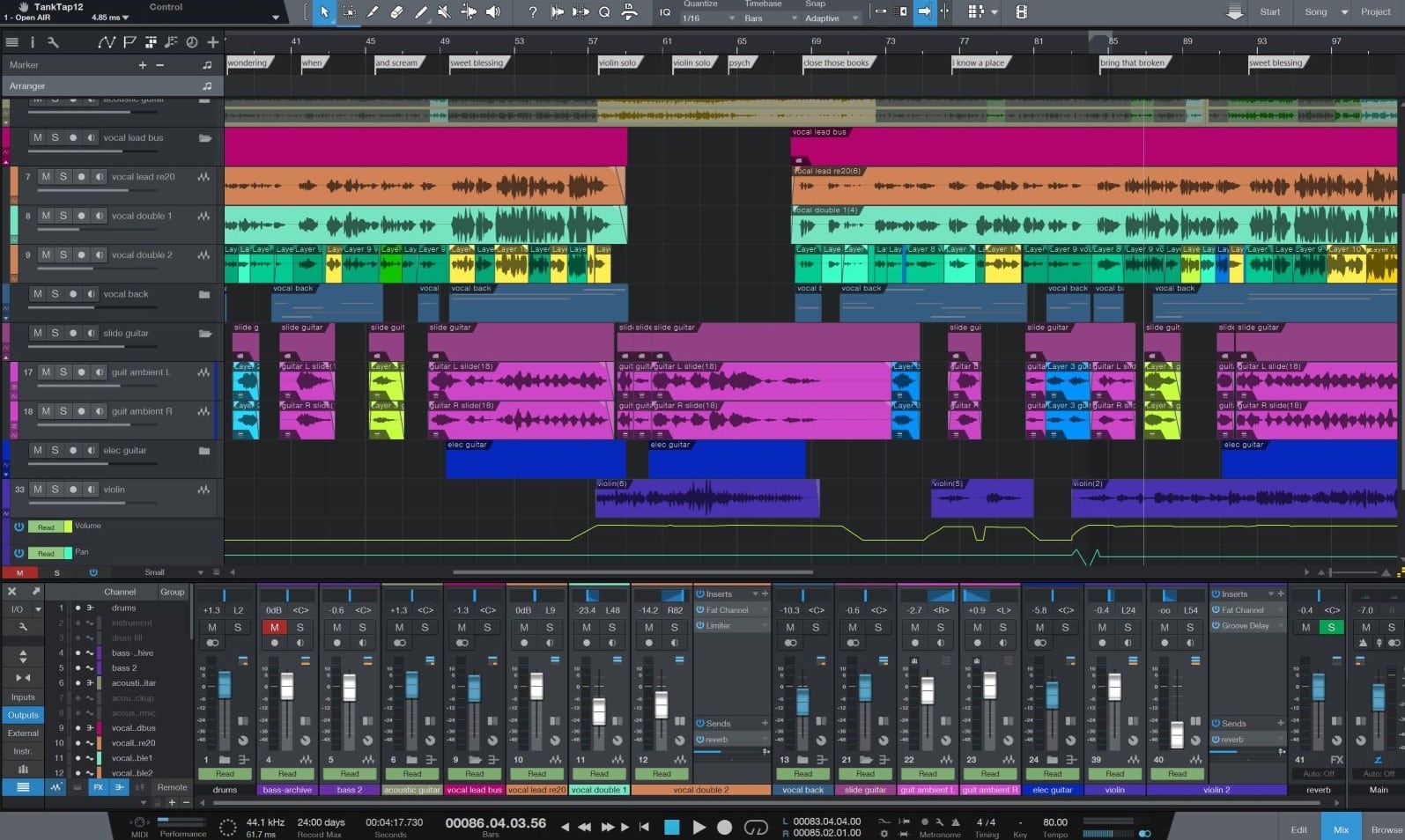
Studio One’s deceptively minimal flat interface is intuitive enough to jump right in, with far fewer clicks, less CPU load, and no momentum-robbing crashes. Its channel editor allows drag-and-drop effect ordering and multiple signal-chain splits for parallel processing — pushing a guitar signal into two different amp plugins, for instance, resulting in a sophisticated sound from a single source. Macro Controls map the most relevant parameters of any effect into one control panel, eliminating the need to double-click through individual effects.
MIDI editing is full of useful shortcuts, with the Humanize function being the most revolutionary. As a tape-era old-schooler, I used to spend inordinate time programming drums organically through a MIDI controller to avoid quantized sound. Now I input the data robotically and Humanize afterward to add spookily real feel. I still can’t get over the idea that I’m cheating — but if it buys several hours to make a better song, I’ll let the algorithm do its thing.
The Arranger Track and Scratch Pads are so essential I wonder why it took this long for someone to invent them. Paint over sections to define composition blocks — Studio One smart-names them as intro, verse, chorus. Drag, resize, edit as ideas develop. The Scratch Pad lets you non-destructively experiment with different compositions without touching the original Arranger track. When a sketch works, drag it over. The workflow is fluid regardless of whether you’re working with MIDI or audio events.
Finally: Native Low-Latency Plugin Monitoring, nicknamed Green Z. I’m still in suspended disbelief that software monitoring can work this well. Your plugins become part of the monitor mix as long as the vendor designed them with less than 3ms latency. One potential glitch — the option was initially unavailable with my Roland or Yamaha USB devices until I installed the PreSonus Universal Control driver. Once installed, it appeared for all devices. Overloud TH3 through Green Z is a revelation: I can now monitor guitar amp simulation while editing drum MIDI simultaneously, converging the creative process of adding effects with the recording performance itself.
God is in the details. After a year of use, Studio One has become transparent — which is the ultimate goal of any great piece of software.
Related Posts
-

Roland GR-55 Guitar Synth
TapeOp #112 review of the Roland GR-55 — and the 5-hour drop-deadline that proved its worth.
-
Roland GK-Kit GT3 Pickup
TapeOp #103 review of the Roland GK-KIT — a discreet guitar synth pickup, still in active use a decade later.
-
Roland Octa-Capture
TapeOp #82 review of the Roland Octa-Capture — a decade in service, still a strong find on the used market.
-
Nakamichi Bx-1
The deck behind the archive, 1987–1993 — on Nakamichi’s pursuit of perfection in a doomed medium.