
Rutger Hauer’s Tears in the Rain monologue at the end of Blade Runner encapsulates the paradox of the fragile line between state-of-the-art and obsolescence. The Replicants represent the pinnacle of technology, yet are haunted by their own expiration — “time to die.” It’s hard not to draw a parallel to Nakamichi, which made the finest cassette decks of the 1980s and 90s while engineering perfection into a medium that was always, by design, doomed.
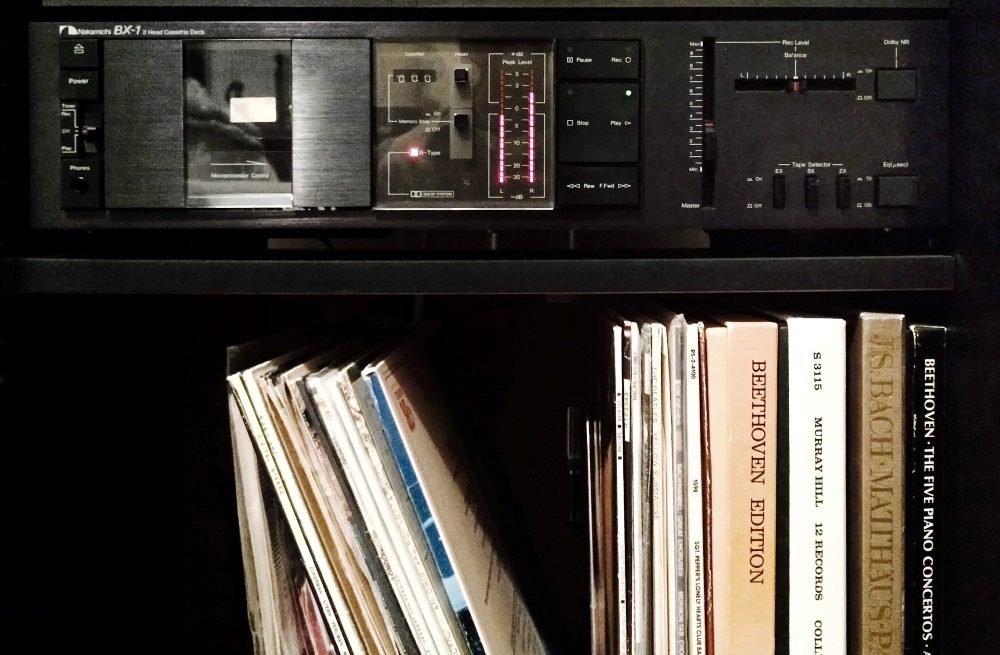
The BX-1 was Nakamichi’s entry-level model — a 2-head, single-capstan deck with full-logic transport, Dolby B noise reduction, and manual bias controls covering normal, chrome, and metal tapes. Nakamichi stripped out anything that degraded the signal path: double-NF circuits in both the recording and playback equalizer amplifiers to reduce distortion, a dedicated constant-voltage power supply for the bias oscillation circuit, and a 1.2μ gap high-bias read/write head with a hyperbolic contact surface. Every unit was individually calibrated across around 30 parameters before leaving the factory. For its price, nothing else came close.
Almost every recording on this site through 1993 — Animus, Resonance, Statik 1, Statik 2, Statik 3, 16:16, and the Wept catalog — was mastered on this deck after being tracked on a Tascam 234 4-track. Listeners still occasionally express disbelief that these recordings originated on cassette. The BX-1 is why.
The cassette was always a compromised medium — invented for compactness rather than fidelity, destined to be surpassed first by CD and then by digital entirely. Nakamichi knew this and pursued perfection within its damned boundaries anyway. When auto-reverse became standard, the azimuth problem — the tape head angle can’t be correct when simply flipped — led to the legendary RX-505: a $1,200 deck that motorized the entire cassette flip — the door popped open and a motor rotated the tape, preserving perfect head alignment without human intervention. At an audio show in DC, a wall of them demonstrated this in unison. An absurd, magnificent solution to an obsolete problem.
The BX-1’s own “time to die” came via what collectors now call Nakamichi Disease — the transport rollers decay prematurely, leaving the mechanism spinning with no traction. A replacement belt and idler tire is the standard fix; units in good shape still fetch $150–300 on the used market and are worth every cent. As analog media makes a comeback from the indie margins, Hauer’s final words land differently — not as nihilistic erasure, but as the weight of a powerful nostalgia that gives obsolescence a new meaning.
Related Posts
-

COtu
Three alt-rock collabs — a transpacific love story, a dictator satire, and a Nugent homage.
-
Farewell (for now) Brian Johnston
A farewell for Brian Johnston — IReverend Brainskan XIII, doubt-leader, and one of the strangest geniuses around.
-
sun*load
Thirty years between high school and this collaboration — four goth/ambient songs and a David Bowie ghost story.
-
Luscious-235
A synthwave collaboration set in the lost decade of the 19A0s — and a rare interview with Luscious-235.